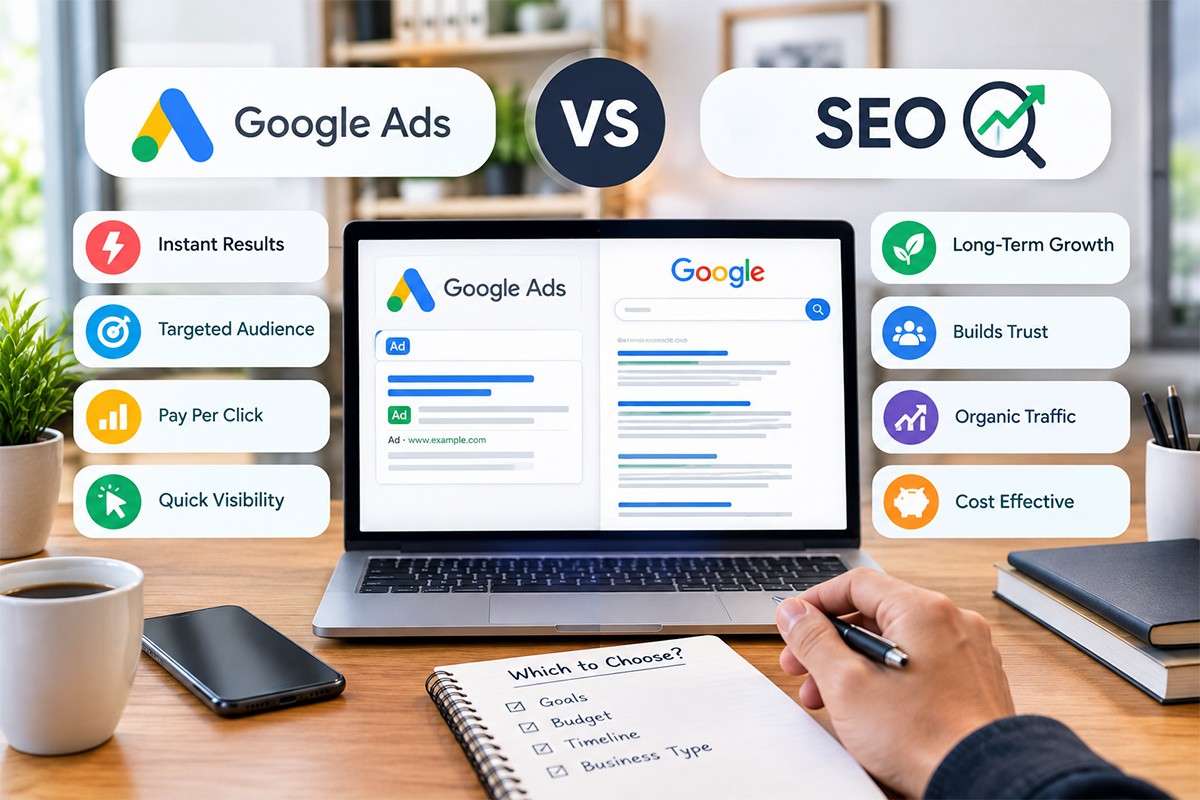
Every business with a limited marketing budget eventually faces the same question: Google Ads vs SEO — which one deserves the first investment? Both channels can drive real, measurable business growth, but they work in fundamentally different ways, on different timelines, and at different costs. Choosing correctly can save months of wasted spend. This guide breaks down exactly how each channel works, their real costs and timelines, and a clear framework for deciding which one your business should prioritize first.
How Google Ads Works
Google Ads is a pay-per-click (PPC) advertising platform where businesses bid on keywords to show paid listings at the top of Google’s search results, marked with a small “Ad” label. You pay only when someone clicks your ad, and traffic starts flowing almost immediately once a campaign goes live — often within hours of launch.
How SEO Works
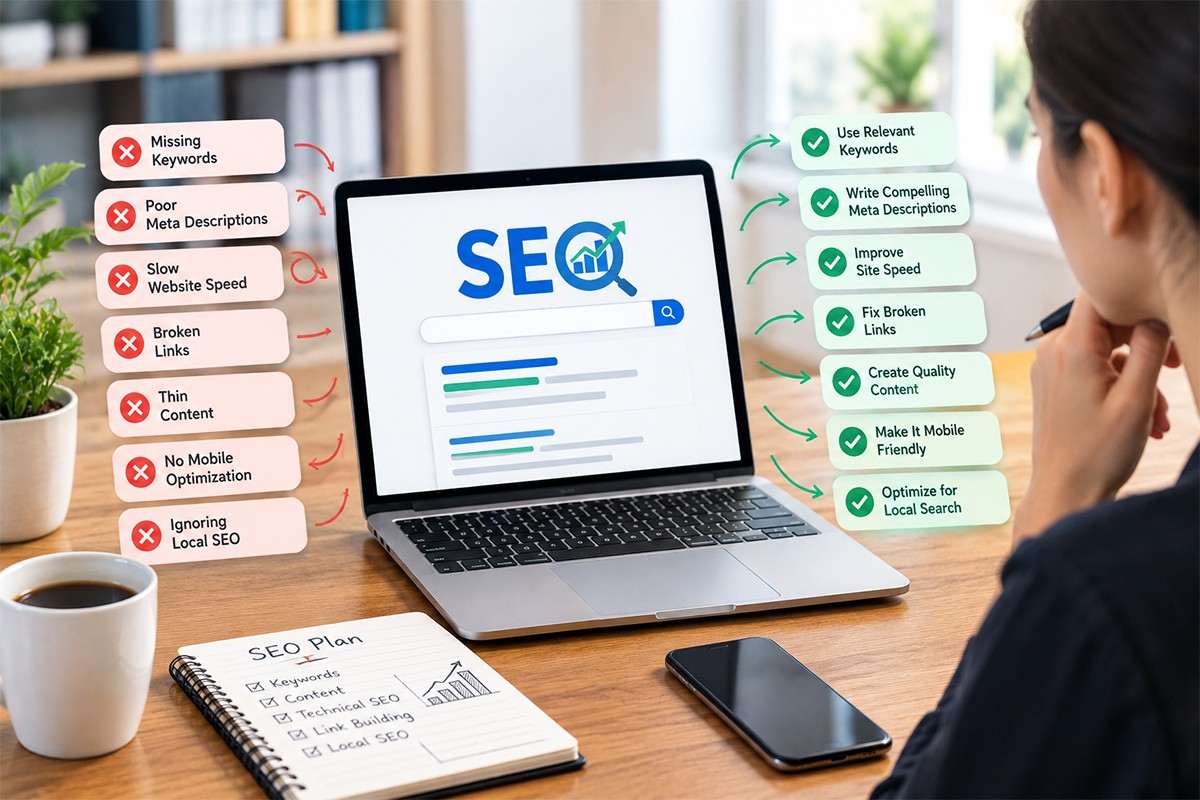
SEO (Search Engine Optimization) is the process of improving your website so it ranks organically — without paying per click — in Google’s regular search results. It involves technical improvements, quality content, and building authority through backlinks, and as covered in our guide on how long SEO really takes to show results, it typically takes 4-6 months for initial movement and 6-12 months for durable rankings.
Google Ads vs SEO: Key Differences
- Speed to results: Google Ads can generate leads within hours of launch; SEO typically takes 4-6 months for initial ranking movement.
- Cost structure: Google Ads charges per click and stops generating traffic the moment you stop paying; SEO requires upfront investment in content and optimization but keeps generating traffic long-term without an ongoing per-click cost.
- Long-term value: SEO traffic compounds over time and becomes more cost-effective per lead as rankings mature; Google Ads costs remain relatively constant or increase as competition for keywords grows.
- Trust and credibility: Many users trust organic results more than paid ads, and industry research from Ahrefs consistently shows organic listings capture a majority of total search clicks.
- Control and flexibility: Google Ads offers precise control over targeting, budget, and timing that can be adjusted instantly; SEO progress is slower to change once content and technical work are in motion.
When Google Ads Should Come First
- You need leads immediately — a new business, a seasonal promotion, or an urgent revenue gap that cannot wait months for organic traffic.
- You want to test messaging and offers quickly before committing to a long-term content strategy built around the same value proposition.
- Your industry has very low search volume, where SEO alone would not generate meaningful traffic regardless of ranking position.
- You have budget for ad spend but limited time to wait for organic momentum to build.
When SEO Should Come First
- You are building a long-term, sustainable growth channel rather than needing immediate results at any cost.
- Your budget is limited and cannot sustain ongoing per-click costs indefinitely.
- Your industry keywords are extremely expensive to bid on, making Google Ads a poor return on investment compared to earning the same visibility organically.
- You have the patience for a 6-12 month investment that pays off with compounding, increasingly cost-effective traffic.
Why the Smartest Strategy Often Uses Both
Rather than choosing one exclusively, many successful businesses run Google Ads to generate immediate leads while SEO builds in the background, then gradually shift budget from paid to organic as rankings mature and organic traffic reduces reliance on ad spend. This hybrid approach avoids the two biggest pitfalls: waiting months with zero traffic, or paying indefinitely for every single visitor. Pairing both with strong content writing and a conversion-ready website ensures traffic from either channel actually converts once it arrives.
A Simple Framework for Deciding
- How urgently do you need leads? Days or weeks favors Google Ads; months favors SEO.
- What is your monthly budget? A smaller, limited budget often stretches further with SEO over time, while a larger budget can support Google Ads without depleting reserves.
- How competitive and expensive are your keywords to bid on? Very expensive keywords make organic SEO increasingly attractive as a long-term alternative.
- How long can your business wait for results? If cash flow requires immediate leads, start with Google Ads while building SEO in parallel.
Getting the Right Mix for Your Business
There is no universally correct answer to Google Ads vs SEO — the right choice depends entirely on your timeline, budget, and industry. Many businesses in Amritsar and beyond work with an experienced digital marketing company in Amritsar like Duggal Infotech to build a strategy that balances both channels correctly from the start, rather than guessing and losing budget to trial and error.
Frequently Asked Questions
Should I start with Google Ads or SEO?
It depends on urgency and budget. If you need leads immediately, start with Google Ads. If you have a limited budget and can wait several months for compounding, long-term results, start with SEO, ideally running both together when possible.
Is Google Ads more expensive than SEO in the long run?
Generally yes. Google Ads requires ongoing per-click spending indefinitely, while SEO requires upfront investment in content and optimization but continues generating traffic without an ongoing per-click cost once rankings are established.
How fast does Google Ads generate results compared to SEO?
Google Ads can generate leads within hours of a campaign going live, while SEO typically takes 4-6 months for initial ranking movement and 6-12 months for durable, competitive results.
Can I run Google Ads and SEO at the same time?
Yes, and many businesses find this the most effective approach — running Google Ads for immediate leads while SEO builds in the background, then gradually shifting budget toward organic traffic as rankings mature.
Do people trust organic search results more than ads?
Many users do perceive organic results as more credible than paid ads, and research consistently shows organic listings capture the majority of overall search clicks compared to paid results.
Is SEO a better long-term investment than Google Ads?
For most businesses, yes. SEO traffic compounds over time and becomes more cost-effective per lead as rankings mature, while Google Ads costs remain ongoing and can increase as keyword competition grows.
When does it make sense to prioritize Google Ads over SEO?
Google Ads makes sense when a business needs leads immediately, wants to test messaging quickly, operates in a low-search-volume niche, or has ad budget but limited time to wait for organic results to build.
Does stopping Google Ads mean losing all traffic immediately?
Yes. Unlike SEO, Google Ads traffic stops almost immediately once a campaign is paused or budget runs out, since paid visibility only exists while you are actively paying for clicks.
How much budget do I need to start with Google Ads or SEO?
Budgets vary widely by industry and competition, but Google Ads typically requires a defined daily or monthly ad spend on top of management costs, while SEO investment usually goes toward content creation, technical work, and link building over several months.
Should a new business start with SEO or Google Ads?
A new business often benefits from starting with Google Ads to generate leads immediately while a new website has no organic authority yet, then investing in SEO in parallel to build sustainable, long-term traffic.